Direct answer: A damaged metal roof panel should not be assigned a repair method from one close-up photo. First identify the panel system, the metal and finish, the exact damage, nearby seams, clips or exposed fasteners, and any warranty requirements. A small fastener or sealant detail may have a limited repair. A localized hole or tear may allow a manufacturer-compatible patch. Large damage, failed seams or clips, repeated movement, or warranty conditions may require full panel replacement.
For a McAllen or Rio Grande Valley homeowner, the practical goal is not to buy the smallest repair at any cost. It is to get a written scope that explains what is damaged, why the proposed method fits the roof system, what the repair will and will not correct, and how the finished work will be documented.
Identify the metal roof system before choosing a repair
Start with the panel profile and attachment method. A standing-seam panel with concealed clips behaves differently from an exposed-fastener panel. The metal type, coating, seam design, panel length, underlayment, and surrounding trim can also change which products and repair details are appropriate.
- Panel manufacturer and product name, when available
- Metal type, thickness or gauge, and finish
- Standing seam, mechanically seamed, snap-lock, or exposed-fastener attachment
- Location of the damage in relation to seams, clips, fasteners, penetrations, eaves, ridges, and transitions
- Whether the roof has an active manufacturer or contractor warranty
The Metal Construction Association’s sealants guide emphasizes that manufacturer and finish-supplier recommendations take precedence. That matters because a product that adheres to one finish or joint design may be unsuitable for another.
When fastener or sealant work may be limited
A crooked or missing fastener, an isolated missing sealant detail, or another small installation defect may be repairable after the surrounding panel condition is checked. The repair still needs the correct fastener or sealant for that panel system. Adding a random screw or smearing sealant over the surface can hide the symptom without correcting the joint below.
MBCI’s panel-repair technical bulletin explains that surface-applied sealant should be considered a short-term repair and that sealant works best between metal pieces in compression. The bulletin also recommends using the manufacturer-recommended sealant. Ask the contractor to name the product, show where it will be installed, and explain whether the detail is temporary or intended as a permanent system repair.
Fastener compatibility matters too. The fastener must match the panel, substrate, attachment detail, and exposure conditions. Our metal roof repair service page explains why visible screws, seams, flashing, and penetrations need a system-level inspection instead of a one-product fix.
When a compatible patch may be considered
A localized puncture or tear may be a candidate for a metal patch if the panel manufacturer allows it and the surrounding panel can support the repair. The proposal should identify the patch metal, finish, dimensions, edge preparation, attachment, sealant, and how water will move around the detail.
- Is the patch material compatible with the existing panel and finish?
- Does the patch cross a seam, rib, clip, or panel joint?
- Can the detail accommodate normal panel movement?
- Will the repair trap water or interrupt the drainage path?
- Does the manufacturer require a specific patch detail or field inspection?
- What visible color or gloss difference should the homeowner expect?
A patch is not automatically a lesser repair. It can be the correct limited repair when it follows the system requirements. It is also not automatically suitable just because it covers the damaged spot.
When full panel replacement may be the safer scope
Full panel replacement may be needed when the hole or tear is severe, the damage reaches a critical seam or attachment, the panel is distorted, clips or seams are compromised, several panels were installed incorrectly, or a warranty requires replacement instead of a field patch. The decision should come from the actual system conditions and manufacturer instructions, not a universal rule.
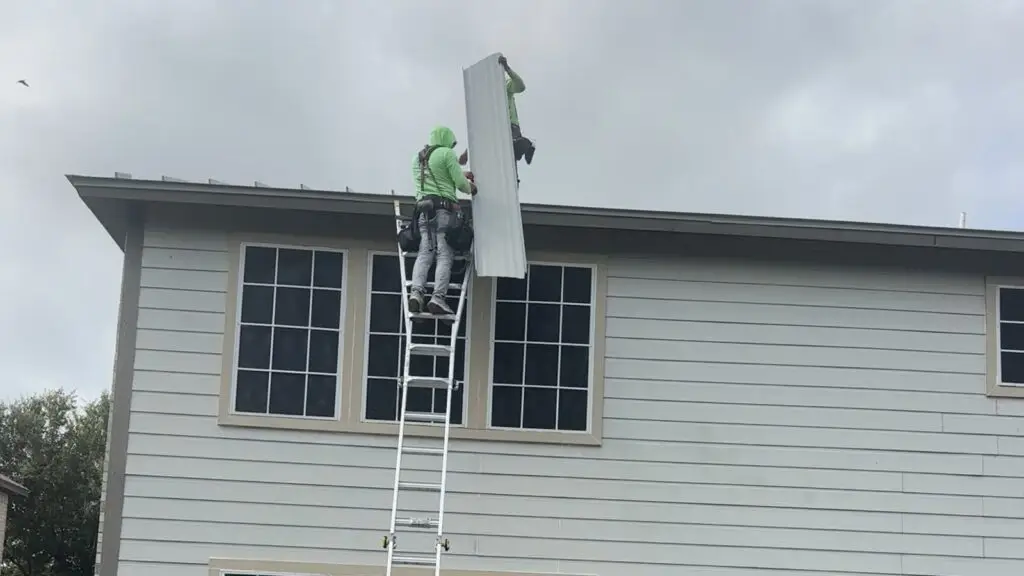
Replacing one panel can affect adjacent panels, trim, closures, fasteners, clips, and sealant. Ask whether the contractor expects to disturb neighboring components and how those items will be restored. Our standing-seam metal roofing guide describes the concealed attachment and seaming features that make this coordination important.
Expect a finish difference on an older roof
A new panel or patch may not match an aged roof exactly. Sun exposure, weathering, dirt, finish type, batch differences, and the availability of the original color can all affect appearance. Ask the contractor to document the selected color and finish and set expectations before the repair begins.
Small scratches are a separate issue from a punctured or structurally damaged panel. If the concern is limited to the finish, read our metal roof scratch and touch-up checklist before approving paint or a coating.
What the repair proposal should show
- Panel identification: profile, attachment, metal and finish information that can be confirmed
- Damage map: overview, medium and close photographs tied to a roof location
- Cause limits: what was observed and what remains unknown
- Selected method: fastener or sealant work, compatible patch, panel replacement, or further evaluation
- Materials: manufacturer, product, color, finish, fasteners, clips and sealants
- Adjacent work: seams, trim, closures, underlayment or neighboring panels that may be disturbed
- Warranty effect: who reviewed the warranty requirements and what written approval is needed
- Completion record: after photos, materials used, repair limits and recommended monitoring
What photos cannot prove
- The exact path water traveled beneath the panel
- The condition of concealed clips, underlayment, decking or insulation
- Whether a visible opening is the only source of water entry
- Whether the repair complies with every project-specific manufacturer, warranty or code requirement
- Whether corrosion or movement extends beyond the photographed area
- Whether a cosmetic mark has affected panel performance
Those limits belong in the report. A clear limitation does not weaken the inspection; it tells the homeowner which facts are confirmed and which questions still require access, testing, manufacturer review, or a different specialist.
Questions to ask before approving the repair
- What panel system and finish are you repairing?
- Which manufacturer instructions support the proposed method?
- Is this a temporary sealant repair, a permanent detail, a patch, or a full panel replacement?
- What nearby seams, clips, fasteners, trim, or underlayment will be disturbed?
- Could the work affect an existing warranty?
- What color or gloss difference should I expect?
- What photographs and material records will I receive after the work?
- What condition should trigger a follow-up inspection?
Get the repair decision in writing
Marva Roofing is a family-owned, veteran-owned roofing company serving homeowners and commercial property owners in McAllen and across the Rio Grande Valley. If your metal roof has a damaged panel, recurring leak, loose fastener, or questionable patch, start with a documented inspection and a system-specific repair scope. Call (956) 217-9989 to discuss the roof and the evidence needed for the next decision.