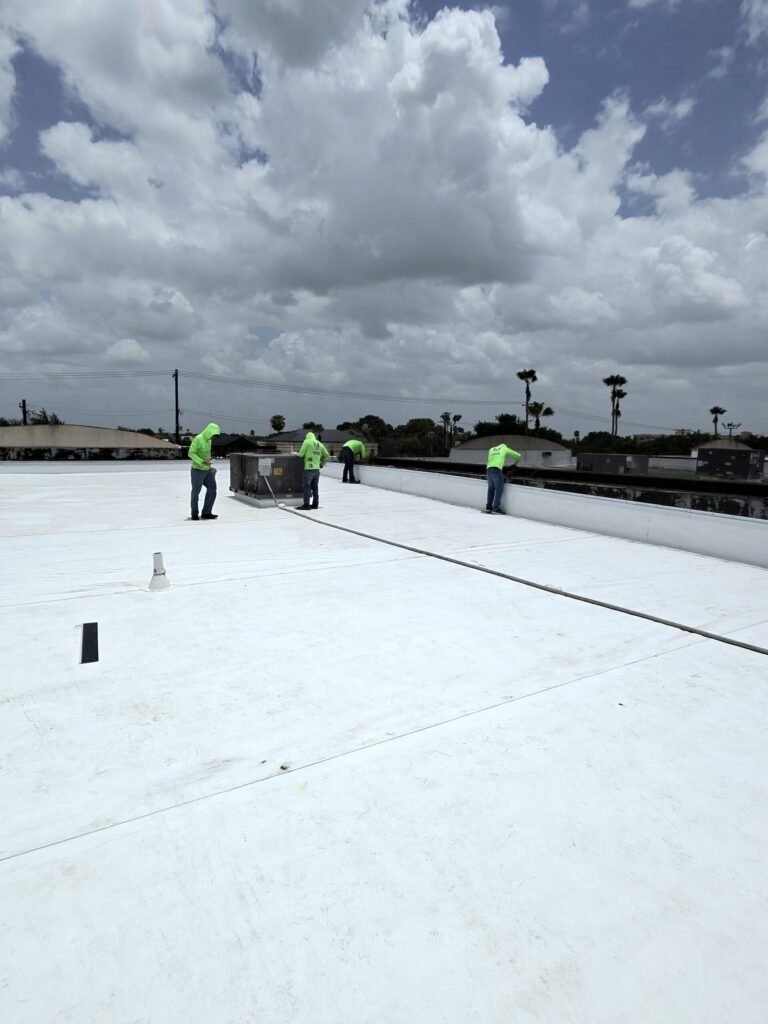
Often, yes. A commercial roof replacement can sometimes be done in sections while the rest of the building stays open. That doesn’t mean every room, entrance or loading bay can stay open every day. Ask your roofer to show you which parts of the building can operate, which have to close temporarily, and what could change that plan.
Start with what has to stay open
Walk the building with the contractor before comparing schedules. Mark the entrances customers actually use, the loading doors your deliveries rely on, and any rooms where dust, noise or a loss of cooling would stop work. A retail shop might be able to shift pickups to another door for a morning. A kitchen or a room with sensitive equipment might need a different work window or a temporary closure. Those are planning examples, not promises that a given building can remain occupied.
Ask for a roof map and a ground-level map
The roof map should show the order of work and what sits below each phase. The ground-level map should show where materials, lifts and dumpsters go, how people enter the building, and where deliveries can still happen. Have the contractor and property team confirm safe access and emergency routes before the phase starts. If a lift needs the only usable entrance, the answer may be a short closure, not a different sign on the door.
Put noise, rooftop equipment and rain in the schedule
Ask when tear-off, material hoisting and fastening will be loudest. Find out whether the proposed materials or methods create odors, and have the property team coordinate with the appropriate building trades before any work affects rooftop air intakes or equipment. Don’t assume every phase affects the same tenants.
Have the roofer explain how each opened section will be protected during the work and left weather-tight at the end of the shift. Ask what forecast or site conditions would stop tear-off, who decides, and who tells the tenants. Finding deteriorated decking or more wet material than expected can change a phase; agree on how that change will be documented and approved.
Put five answers in writing before work starts
- Which roof section and rooms below it are affected in each phase?
- Which entrances, parking spaces and loading areas stay available?
- When should tenants expect noise, odors, equipment work or a temporary closure?
- How will the opened roof be protected, and what happens if weather or hidden damage changes the schedule?
- Who sends notices, handles a same-day change, and confirms a work zone can reopen?
Compare that plan alongside the roofing scope and price. A shorter schedule is not necessarily better if it closes the one door your business needs. Keeping the building open is also not a reason to choose an overlay unless the existing roof and proposed system are suitable. Our commercial roof replacement overview explains the broader scope.
Johns Manville’s reroofing guide emphasizes evaluating the existing roof and protecting occupants. A Sika project case study shows how another contractor coordinated a partly occupied building; it is not a Marva project or a guarantee that the same approach is suitable elsewhere.
If you manage a property in McAllen or the Rio Grande Valley, request a roof inspection. Bring your operating hours, delivery schedule and the areas that can’t go offline so those constraints can be discussed before the scope is set.