When comparing commercial roofing quotes, start with what each contractor is proposing to do: which buildings and roof sections are included, whether the work is a repair or replacement, what materials will be removed, which system will be installed, and what warranties apply.
Two prices are only useful to compare once you understand those differences.
The question I ask is: “Are you looking for the cheapest option or the best option for your budget?”
Your budget matters. A good roofing recommendation should explain how that money will address the condition of your building.
Make sure the quote identifies the building and the work
Before comparing materials or prices, make sure you can answer a basic question: What exactly does this estimate cover?
A property with several buildings—or one building with different roof sections—needs a clear scope. Ask the contractor to identify the included areas on a photo, drawing, or written building list.
The proposal should distinguish repairs, coating, and replacement. It should also identify quantities, exclusions, and how additional work will be priced if concealed damage is found. Our roofing estimate exclusions checklist helps you review those boundaries.
“Roof work” is too broad to tell you what you are buying.
Check whether the recommended system fits every roof section
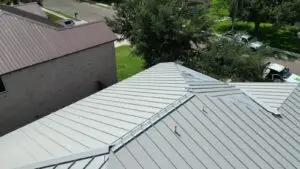
We have had customers show us estimates specifying shingles across an entire structure. Our inspection found sections where the slope did not meet the manufacturer’s requirements for shingles.
Our proposal included modified bitumen for those lower-slope areas.
That changes the comparison. The estimates are proposing different roof assemblies, even if both appear to cover the same building.
GAF identifies 2:12 as the minimum slope for its asphalt shingles and specifies additional installation requirements for slopes from 2:12 to below 4:12. The exact product instructions and applicable local requirements must guide the installation. See GAF’s minimum-slope guidance.
Ask: “Did you measure each roof section’s slope, and why is this system suitable for it?”
For buildings with lower-slope sections, our commercial modified bitumen guide explains that option in more detail.
Find out whether the price includes a tear-off or an overlay
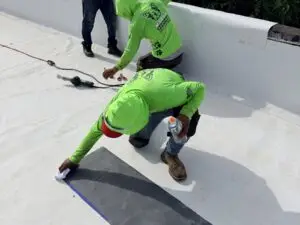
One of the first things I check is whether the proposal includes removing the existing roof or installing another system over it.
Ask what stays, what comes off, and what inspection supports that decision. Also ask how the contractor will handle unsuitable materials discovered during the work.
We have been asked to correct unfinished roofing jobs where the original contractor had not properly investigated the existing assembly before estimating the project. Those experiences are why I put value on understanding the roof before pricing the work.
Inspection may include core samples or other testing appropriate to the assembly and proposed system. For example, GAF’s adhered TPO/PVC manual calls for representative test cuts to verify existing roof construction and condition. That is a system-specific requirement, not a blanket rule for every roofing job. See the GAF installation manual.
Ask why replacement—or keeping the existing roof—makes sense
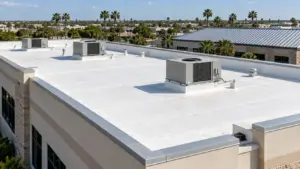
Sometimes an owner requests a replacement, but our inspection finds the existing roof surface and substrate are still in good condition. In suitable cases, we recommend a coating to extend the existing system’s service life and reduce immediate expense.
A coating recommendation still needs to account for the existing materials, condition, preparation, and compatibility. GAF’s liquid-applied roofing manual requires compatibility with the existing roof and describes adhesion testing before application. See the GAF liquid-applied roofing manual.
Our commercial roof coatings page explains the restoration approach.
The reverse also happens. Owners ask us to repair older shingle roofs, and the repairability assessment raises concerns about spending more money on isolated work.
On the older roofs we evaluate, the important question is whether a repair can provide useful service without creating further problems. Age informs that conversation, but the recommendation should explain the roof’s actual condition.
Compare warranty coverage, then check who stands behind it
I look at both the roofing-system coverage and the workmanship coverage.
Ask for the actual warranty documents. Confirm who provides each warranty, what it covers, what it excludes, and what the owner must do to maintain coverage.
Manufacturer material coverage does not automatically include installation workmanship. GAF’s commercial warranty comparison, for example, distinguishes products with material coverage from guarantees that also include workmanship. See GAF’s commercial warranty comparison.
Then do your homework on the manufacturer and contractor. Check their track records and ask about experience with the specific system being proposed.
A warranty deserves more attention than the number of years printed beside it.
Use this checklist before choosing a quote
| What to compare | What the proposal should explain |
|---|---|
| Building and roof areas | Which structures and sections are included |
| Type of work | Repair, coating, overlay, or replacement |
| Removal | What will be torn off and disposed of |
| Inspection findings | What was checked and what remains uncertain |
| Roof system | Why it fits the slope and existing conditions |
| Quantities and details | Areas, materials, transitions, and other included work |
| Exclusions and changes | What costs extra and how changes are approved |
| Warranties | Provider, coverage, exclusions, and owner responsibilities |
| Installation plan | Crew experience, property protection, and coordination with operations |
Price is not everything. A well-executed plan, a crew trained on the system being installed, and experienced staff have value that may not be obvious from the total on an estimate.
For a property in McAllen or the Rio Grande Valley, start with an inspection and a clear explanation of the options. Learn more about our commercial roofing services.
Frequently asked questions
Why are two commercial roofing quotes so different?
They may cover different areas, removal work, systems, preparation, or warranties. Compare the written scopes before comparing totals.
Can one building need more than one roofing system?
Yes. Different roof sections may have different slopes and installation requirements. The proposal should identify those sections and explain the selected systems.
Does requesting a replacement mean I need one?
No. An inspection may identify a viable repair or restoration option. Ask what findings support each recommendation.
Should a shingle roof be replaced simply because it is 15 years old?
Age alone should not decide the scope. Ask the contractor to explain its condition, repairability, and whether the proposed repair is a worthwhile investment.