Commercial Roofing Guidance for McAllen, Mission, Edinburg, Pharr & the Rio Grande Valley
Best Commercial Roof System for Texas Heat
Best Commercial Roof System for Texas heat is not a one-size-fits-all answer for properties in McAllen. The right system depends on slope, drainage, insulation goals, roof traffic, tenant sensitivity, long-term maintenance expectations, and how the building performs under extreme sun, sudden rain, and wind-driven storm activity. For property owners and managers, the better question is not just which roof sounds best on paper. It is which roof system gives your specific building the strongest balance of performance, repairability, lifecycle value, and operational reliability in South Texas conditions.
- Veteran-Owned
- Family-Owned
- Commercial Roof Inspections
- Flat & Low-Slope Expertise
- South Texas Heat Guidance
What Makes a Commercial Roof System Perform Well in McAllen Heat
Use this guide to compare commercial roof systems by heat performance, drainage, roof traffic, repairability, lifecycle cost, maintenance needs, and operational risk in South Texas conditions.
- TPO, metal, modified bitumen, and roof coating comparisons
- Repair versus replacement decision factors
- Inspection, emergency response, and documentation guidance
- Maintenance and asset protection planning
Table of contents
Jump to the commercial roofing question you need
Why Texas Heat Changes the Commercial Roofing Conversation
In McAllen and across the Rio Grande Valley, commercial roofs deal with more than just “hot weather.” They face prolonged UV exposure, repeated expansion and contraction, intense rooftop temperatures, sudden rain events, and heavy stress at seams, penetrations, drains, perimeter edges, and equipment curbs. That means heat does not just make a roof surface hotter. It amplifies weakness in the details that determine whether a roof performs predictably or becomes a recurring maintenance problem.
For low-slope and flat commercial roofs, the best system for Texas heat often comes down to how well it handles reflectivity, movement, drainage, traffic, and repairability. Reflective membranes can reduce heat absorption. Multi-ply systems may offer added durability in traffic-heavy zones. Metal systems can perform well in many commercial settings, but detailing and thermal movement matter. Roof coatings may be effective on qualifying substrates, but not every existing roof is a candidate. In other words, there is no serious commercial roofing strategy that starts with product preference alone.
The right commercial roofing recommendation should begin with the building’s use, operational sensitivity, current roof condition, and long-term ownership plan. That matters whether you manage a retail center, a warehouse, a multi-family complex, a church, a medical building, or an owner-occupied facility where downtime is expensive.
Seam and Detail Fatigue
Texas heat puts constant stress on seams, penetrations, edge metal, and transition areas. When these details are weak, leaks often begin there long before the broader field appears to fail.
Ponding Water and Slow Runoff
Even the best membrane can underperform when water sits too long. Ponding water raises risk around seams, flashing, and structural low spots.
Wind Uplift and Perimeter Stress
Commercial roofs in McAllen must handle wind pressure at edges, corners, and terminations. That is where improperly detailed systems often show early distress.
HVAC Traffic and Rooftop Activity
More rooftop equipment means more penetrations, more service traffic, and more opportunity for damage if the system is not designed and maintained correctly.
Why Commercial and Multi-Family Properties Face Higher Roofing Risk
Commercial and multi-family roofs are not just larger versions of residential roofs. They have more operational pressure, more rooftop equipment, more penetrations, more drainage variables, and more financial exposure when something goes wrong. An active leak on a single-family home is serious. A leak over tenant space, inventory, office equipment, or common areas can turn into business disruption, resident complaints, interior damage, and budget volatility fast.
Multi-family and HOA-managed properties are especially sensitive because roofing issues affect more than one unit and often involve access planning, tenant communication, repeated maintenance calls, and reputation risk. Retail centers and warehouse properties face their own version of the same problem. One weak roof detail can create recurring service calls, interior interruptions, and avoidable long-term asset deterioration.
That is why property managers and owners should evaluate commercial roofing systems based on lifecycle value, not just lowest bid. Roof performance in Texas heat has to be measured against repair frequency, traffic durability, insulation strategy, drainage performance, and how easy the system is to inspect, document, and maintain over time.
Inspection and Diagnostic Process: How the Right System Is Actually Chosen
The best commercial roof system for Texas heat is not selected from a brochure. It is selected through inspection, documentation, and system matching. A serious commercial roof evaluation should review slope, drainage, membrane or panel condition, flashing details, seams, perimeter terminations, insulation concerns, rooftop traffic, ponding zones, and the condition of penetrations and curb areas.
That process should also account for how the building is used. A warehouse with minimal foot traffic and broad low-slope areas may point toward a different solution than a retail center with heavy service traffic, complex penetrations, and high tenant sensitivity. Likewise, a multi-family property may need a system strategy that prioritizes repairability, disruption control, documentation, and phased planning.
Good diagnostics do more than identify visible problems. They separate isolated failure from broader end-of-life issues. They help determine whether the building is a candidate for targeted Commercial Repair McAllen, restoration, or full replacement. And they create the documentation needed for maintenance planning, insurance conversations, and capital budgeting.
Roof Walk and System Review
Visual review of membrane or panel condition, flashing, penetrations, drainage, perimeter details, and visible distress patterns.
Leak-Path and Failure Analysis
Tracing water entry and failure points instead of guessing based only on where water appears inside the building.
Photo Documentation
Before-during-after documentation that supports management decisions, service history, and storm-related records.
System Recommendation
Matching the roof type to slope, budget, heat performance, traffic needs, and long-term ownership goals.
Emergency Response Matters When Leaks Threaten Operations
If the building has an active leak, the first priority is not debating long-term theory. It is stabilizing the situation, protecting the interior, and identifying whether the problem is localized or part of a broader system failure. Emergency response is especially important for offices, retail centers, industrial space, and multi-family properties where delay can create interior damage, safety concerns, or tenant disruption.
Short-term dry-in and temporary control measures can be the right first move, but they should never be mistaken for a full strategy. A true commercial roofing response should document the problem, reduce immediate exposure, and move quickly into diagnosis. The longer a building stays in reactive mode, the harder it becomes to manage long-term roof costs strategically.
For properties already showing recurring leak points, it is often smarter to pair immediate repair with a broader inspection of drainage, flashing, seams, and thermal stress areas rather than treat each service call as a separate issue.
Insurance Claims and Documentation for Commercial Roof Damage
Not every commercial roof issue is an insurance event, but when storms, wind-driven rain, or sudden damage are involved, documentation becomes a business protection tool. Commercial roof claims often depend on clear records, photo evidence, visible damage patterns, and a practical explanation of what is storm-related versus what is wear, maintenance, or end-of-life deterioration.
Property owners and managers benefit most when documentation starts early. That includes images of impacted areas, notes about active leak zones, condition reporting, and clear descriptions of how the damage affects performance. Good documentation also helps when communicating with ownership groups, boards, tenants, and maintenance teams.
The goal is not to force every roofing problem into a claim conversation. The goal is to create a clean factual record so the next decision is based on evidence instead of assumptions.
Comparing Commercial Roof Systems for Texas Heat
When owners ask for the best commercial roof system for Texas heat, they usually want one answer. In practice, the answer depends on the building. Still, some systems consistently make more sense than others depending on heat exposure, slope, drainage, and maintenance goals.
TPO Roofing
TPO is often a strong fit for low-slope commercial buildings in hot climates because of its reflective surface and popularity in energy-conscious roof design. It can be an excellent option when installation quality, seam integrity, and detail work are handled correctly. Explore Commercial TPO Roofing McAllen.
Metal Roofing
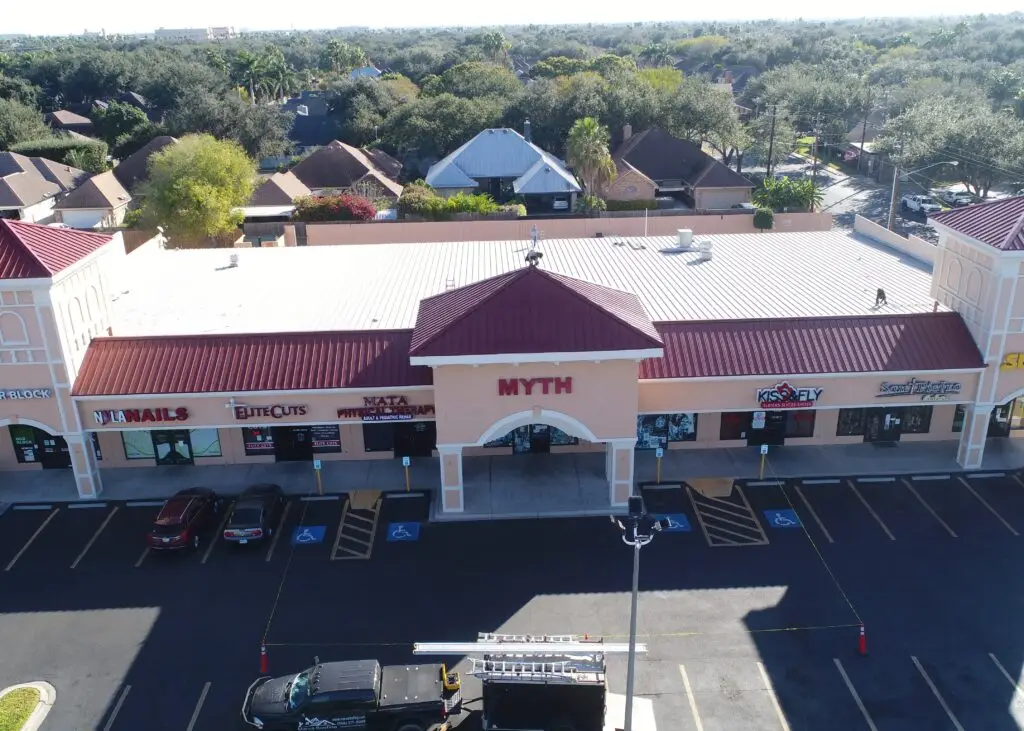
Metal can perform very well in commercial applications, especially where slope, durability, and long-term service life are priorities. But thermal movement, fasteners, seams, and weatherproof detailing must be managed correctly. Explore Commercial Metal Roofing McAllen.
Modified Bitumen
Modified bitumen can be a dependable option in traffic-sensitive or durability-driven environments, especially where a multi-ply assembly is valuable. It may be a strong choice when impact resistance and robust field protection matter. Explore Commercial Modified Bitumen Roofing McAllen.
Roof Coatings
Coatings can be a smart restoration strategy on qualifying roofs, but they are not a universal answer. The existing roof has to be a real candidate for restoration, not just a roof owners hope to save. Explore Commercial Roof Coatings McAllen.
There are also properties with steeper commercial sections or mixed-use designs where Commercial Asphalt Shingle Roofing McAllen may play a role. But for broad low-slope commercial applications in McAllen, selection usually centers on membrane, metal, or restoration strategies based on performance goals and building realities.
In most cases, the best answer is not just the “coolest” roof surface. It is the system that combines heat response, durability, repairability, drainage compatibility, and disciplined installation. That is what turns a roof system into an asset instead of a maintenance burden.
Repair Makes Sense When Failure Is Isolated
If the roof system still has service life left and the issues are limited to details, penetrations, drains, seams, or a defined area, targeted repair may be the most responsible move. See Commercial Roof Repair and Commercial Leak Repair McAllen.
Replacement Makes Sense When Problems Repeat
If seams are failing in multiple zones, insulation is compromised, ponding is chronic, or service calls keep expanding, replacement often becomes the lower-risk option. See Commercial Roof Replacement.
Compare Lifecycle Cost, Not Just Initial Price
The cheapest proposal can still become the most expensive option if it creates more tenant disruption, more leak calls, and more unplanned maintenance spending.
Think Operationally, Not Just Technically
The right decision protects business continuity, simplifies maintenance planning, and supports better capital forecasting over time.
Cost, Scope, and Risk Factors Property Owners Should Weigh
Commercial roofing cost is shaped by far more than square footage. Roof design, tear-off needs, insulation requirements, drainage correction, edge metal, penetration count, access limitations, safety planning, and staging complexity all affect scope. For heat-focused decisions, insulation goals and surface reflectivity can also influence how owners think about long-term value.
That is why owners and managers should be careful about comparing commercial roofing proposals on number alone. One scope may include full detail replacement, drainage correction, walkway pads, and documentation. Another may underprice those same needs by leaving them out or minimizing them. A better bid comparison asks: What risk is actually being removed, what future maintenance pressure is being reduced, and what level of performance is the building buying?
When planning capital work, it also helps to separate roof cost from business interruption cost. A system that reduces leak exposure, call volume, and tenant disruption often delivers value that goes beyond the roofing line item itself. For more budgeting context, see Commercial Roofing Cost and Commercial Roof Lifespan Texas.
Schedule Recurring Inspections
Routine review before and after storm seasons helps catch weak seams, drainage issues, and penetration failures before they become interior problems. See Commercial Roof Inspection.
Control Ponding and Drainage Issues
Slow drainage creates avoidable stress on low-slope systems. Monitor drains, scuppers, and recurring water-holding zones. See Commercial Ponding Water Repair McAllen.
Track Repairs and Service History
Documentation turns roofing into a managed asset instead of a recurring surprise. Maintenance records improve decision-making, budgeting, and storm response.
Use Maintenance to Extend Roof Life
Proactive maintenance can reduce emergency calls, improve predictability, and help owners get more value from the roof they already have. See Commercial Roof Maintenance.
Why Commercial Property Owners Choose Marva Roofing
Marva Roofing’s commercial approach fits owners and managers who need more than a generic roofing bid. They need a contractor that understands heat stress, drainage, system compatibility, documentation, and what repeated roof problems actually cost in the real world. They also need a partner who understands that commercial roofing decisions affect tenants, operations, schedules, and long-term asset planning.
That means clear inspections, practical recommendations, photo documentation, honest repair-versus-replacement guidance, and a focus on systems that make sense for the building instead of chasing shortcuts. Whether the property needs strategic Commercial Storm Damage Repair McAllen, leak diagnostics, phased maintenance, or a full replacement plan, the goal is the same: protect the asset and reduce future disruption.
For broader commercial guidance, visit the main Commercial Roofing McAllen page. For additional industry context, property teams can also review roofing guidance from NRCA and manufacturer education resources from Owens Corning.
Related Commercial Roofing Resources
- Commercial Roof Repair
- Commercial Roof Replacement
- Commercial Roof Inspection
- Commercial Roof Maintenance
- Commercial TPO Roofing McAllen
- Commercial Metal Roofing McAllen
- Commercial Asphalt Shingle Roofing McAllen
- Commercial Roof Coatings McAllen
- Commercial Modified Bitumen Roofing McAllen
- Commercial Leak Repair McAllen
- Commercial Storm Damage Repair McAllen
- Commercial Ponding Water Repair McAllen
- Commercial Roofing Cost
- Best Commercial Roof System for Texas Heat
- Commercial Roof Lifespan Texas
For project education and visual roofing walkthroughs, visit Marva Roofing on YouTube.
Frequently asked questions
Frequently Asked Questions
What is the best commercial roof system for Texas heat?
The best commercial roof system for Texas heat depends on the building’s slope, drainage, insulation goals, rooftop traffic, penetrations, and long-term maintenance expectations. TPO, metal, modified bitumen, and coating strategies can all make sense depending on the property.
Is TPO the best option for hot climates like McAllen?
TPO is often a strong option for low-slope commercial properties in hot climates because reflective membranes are commonly used as part of heat-conscious roof design. But the real result depends on installation quality, seam integrity, drainage, and overall detailing.
How do I know whether my commercial roof needs repair or replacement?
If issues are isolated and the system still has service life left, targeted repair may make sense. If leaks are repeating, seams are failing in multiple areas, insulation is compromised, or ponding is chronic, replacement may be the more stable long-term decision.
Why do multi-family and commercial roofs fail faster than owners expect?
Commercial and multi-family roofs often have more penetrations, more service traffic, more drainage variables, and more exposure to deferred maintenance. That combination creates more stress points than many owners realize.
Can maintenance really extend the life of a commercial roof?
Yes. Routine inspections, drainage management, seam review, penetration checks, and documented repair history can reduce avoidable failure and improve long-term planning.
Choose the Right Roof System Before Heat and Leaks Turn Into Budget Problems
If you are evaluating roof performance, comparing replacement options, or trying to determine the best commercial roof system for Texas heat on your McAllen property, start with a professional inspection. Marva Roofing helps owners, managers, and multi-family decision-makers make clear roofing decisions with documented findings, practical recommendations, and systems selected for real South Texas conditions.