
Commercial Roofing Cluster • McAllen, TX • Retail Centers, Offices, Warehouses, Churches & Multi-Family
Commercial Wind Damage Roof Repair McAllen
After a wind-driven storm, commercial roof damage is not always obvious from the ground. Marva Roofing repairs wind-stressed commercial roofs in McAllen with documented inspections, temporary dry-in for occupied buildings, and targeted repair planning for edge metal movement, membrane uplift, fastener loss, metal panel displacement, and sudden leaks.
- Veteran-Owned
- Family-Owned
- Occupied-Building Planning
- Temporary Dry-In Support
- Insurance-Aware Guidance
Wind-specific repair and dry-in for commercial roofs
This page is intentionally narrower than the broader commercial storm page. It is built for post-wind repair on retail centers, office buildings, warehouses, churches, and multi-family properties where temporary protection, documentation, tenant impact, and fast repair planning matter.
- Edge metal, coping, fascia, and perimeter-securement concerns
- Membrane uplift, seam stress, and detail movement
- Fastener loss and metal panel displacement
- Sudden leak response and temporary dry-in planning
- Repair-vs-replacement clarity for occupied buildings
Start with documentation and dry-in before bigger decisions
Schedule Your Commercial Wind Damage Inspection
When wind has moved roof edges, lifted membrane, loosened fasteners, or opened a new leak path, the smartest first step is a documented inspection. That gives you a clearer path into temporary protection, targeted repair, broader storm response, or replacement planning without guessing.
Commercial WInd damage
Commercial wind repair guide
This page is about wind-driven failure points and business protection, not generic storm language
Commercial Wind Damage Roof Repair McAllen should answer practical questions for property owners and managers. Did the wind move the edge metal? Is the membrane lifting at the perimeter or corners? Have fasteners backed out or pulled loose? Did metal panels shift enough to open a water path? Does the building need temporary dry-in right now, or can it move into a more controlled repair plan?
This page sits inside the commercial roofing silo as a more specific decision page. It supports Commercial Roofing McAllen as the main pillar, connects closely to Commercial Roof Inspection McAllen for broader condition review, and stays separate from Commercial Storm Damage Repair McAllen, which handles wider hail, rain, and multi-cause storm response.
If your biggest problem is already active interior water intrusion, move directly into Commercial Roof Leak Repair McAllen. If the broader need is general system repair beyond wind, use Commercial Roof Repair McAllen.
Table of contents
Jump to the wind-damage answer you need
Quick answer for property owners
A strong commercial wind repair page should tell you what moved, what must be protected now, and what comes next
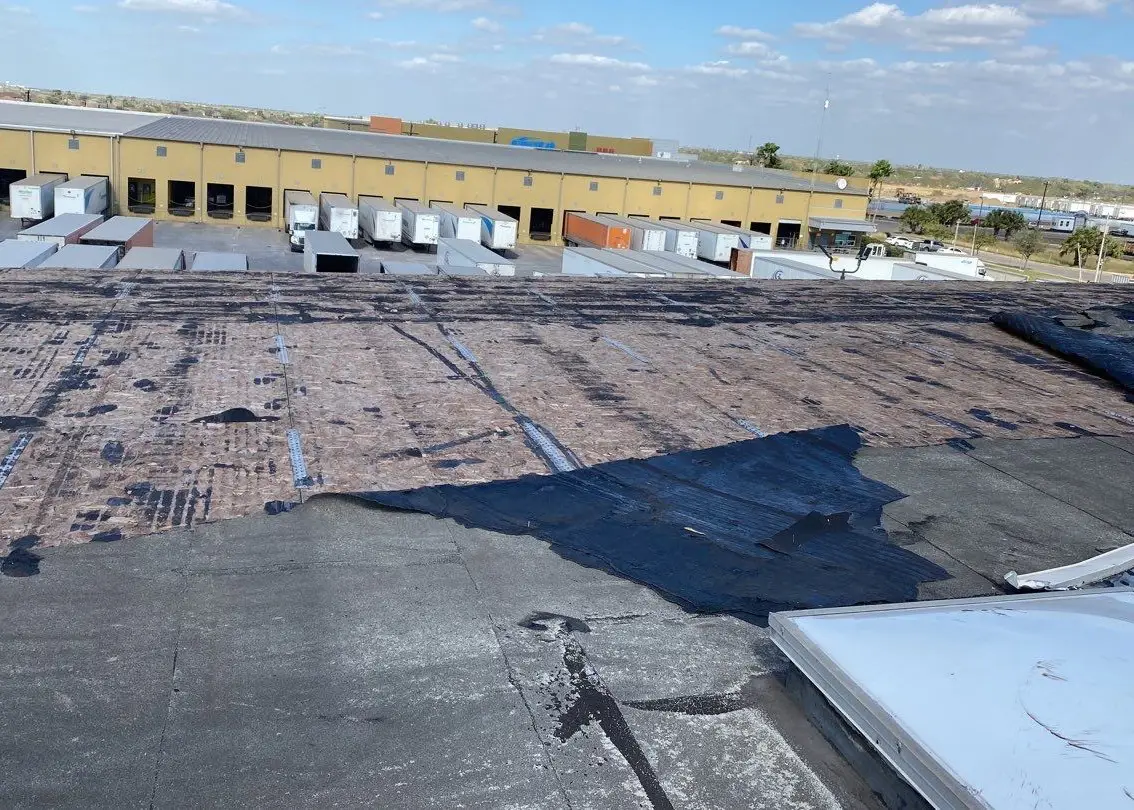
Commercial wind damage is often progressive, not dramatic. A roof can look mostly intact from the parking lot while edge metal is loosening, membrane attachment is being stressed, fasteners are backing out, or metal panels have shifted just enough to create the next leak path. That is why the first job is not guessing. It is documenting the roof, identifying immediate risk, and protecting the building before the next rain turns a roof issue into an operations problem.
A useful wind repair plan should separate what needs temporary dry-in right now from what belongs in targeted repair, broader storm work, maintenance follow-up, or replacement planning. That keeps owners from overreacting to small issues while also keeping them from underreacting to failure points that can open fast.
The goal is clarity. Ownership, facilities teams, property managers, boards, and insurance contacts should be able to look at the same documentation and understand what the wind actually changed.
- What you should receive: photos, roof-area notes, and plain-language findings.
- What should be checked: edges, membrane securement, seams, fasteners, panels, trim, drains, and penetrations.
- What should be explained: immediate leak risk now versus items that can be scheduled.
- What should be decided: dry-in, repair, maintenance follow-up, or replacement planning.
Target property types
Retail centers, office buildings, warehouses, churches, and multi-family properties all need a different wind-response plan
Retail centers and shopping strips
Retail roofs often need suite-by-suite awareness because one wind-opened leak can affect signage areas, storefront transitions, back-of-house space, and tenant hours all at once. Documentation should help management prioritize protection without shutting down the whole property.
Office and medical buildings
Finished interiors, ceiling systems, electronics, and business continuity raise the cost of waiting. Office properties usually need faster leak-path tracking and a cleaner temporary dry-in plan before the next weather event.
Warehouses and industrial buildings
Large low-slope fields, long perimeters, dock canopies, rooftop units, and inventory exposure make warehouse wind damage especially important. Small perimeter movement can become a much bigger interior problem once wind-driven rain follows.
Churches and ministry buildings
Church campuses often combine sanctuaries, fellowship halls, classrooms, and covered walkways with mixed roof types. Reporting should be easy to share with leadership teams that need a clear repair path and scheduling plan around services and events.
Multi-family and apartment properties
Wind damage at apartment roofs is about more than the roof surface. It also affects resident communication, unit prioritization, staging around occupied buildings, and leak response by building or stack instead of vague whole-property language.
Managed mixed-use properties
Properties with ownership groups, approval layers, or portfolio-level budgeting benefit from documented findings that separate urgent dry-in from repair scope and longer-term capital planning. That is where photo-based reporting becomes especially useful.
Wind damage by roof system
Wind does not show up the same way on every commercial roof
Single-ply membranes
TPO and similar single-ply roofs need perimeter, corner, seam, and detail review because wind can lift the membrane, stress attachments, and open failure points that are easy to miss until the next rain hits.
Modified bitumen systems
Low-slope asphaltic systems may show sheet lift, lap stress, flashing pull-back, or surfacing damage where wind found an older weak point and made it worse.
Commercial metal roofs
Metal roofs need more than a quick look for missing pieces. Fastener loss, panel movement, loose trim, open laps, and displaced edge details can all create sudden leak paths.
Edge metal and perimeter details
Perimeters and corners often carry the biggest wind stress. Coping, fascia, edge metal, nailers, and related securement details should be documented carefully because failure at the edge can grow quickly once the roof system starts to open up.
Coated and restored roofs
Coated roof systems should be checked at seams, penetrations, edges, and previous repair areas because wind can reopen weak transitions or expose areas that were already close to the next restoration cycle.
Steep-slope commercial sections
Apartment buildings, churches, and mixed-use properties may also have shingle or steeper roof sections that need their own wind review instead of being lumped into the low-slope report.
If wind damage has already created active interior water intrusion, pair this page with Commercial Roof Leak Repair McAllen. If wind exposed an older roof that was already vulnerable, Commercial Roof Maintenance McAllen may also be part of the next-step conversation.
Why scopes and budgets vary
Two buildings hit by the same wind event can still need very different repair plans
Perimeter exposure and building height
A building with long exposed edges, parapets, canopies, or stronger corner exposure may show more serious movement than a lower, more protected building nearby.
Age and prior repair history
A newer roof with isolated wind-related movement is a very different repair decision than an older roof that already had weak edge details, seam fatigue, or repeated patch history before the storm.
System type and attachment method
Mechanically attached membrane, fully adhered membrane, modified bitumen, and metal panel systems do not fail the same way. Repair scope should follow the actual assembly, not a one-size-fits-all storm assumption.
Occupancy and interior sensitivity
A warehouse with open space, a medical office with electronics, and a multi-family property with occupied units do not carry the same leak risk or the same urgency when scheduling temporary protection and repairs.
Already seeing water inside?
Move directly into leak response and temporary protection when wind has already opened the roof
If a recent wind event is already showing up as drips, ceiling staining, wet insulation, or tenant complaints, the right next step is not waiting to see if it gets worse. Move quickly into documented leak-focused service and temporary dry-in planning.
Documentation and records
A usable wind report should help owners, managers, and insurers talk about the same roof
Photo documentation by roof area
Wide photos, close-ups, and organized roof-zone notes help reduce confusion. You should be able to see which perimeter, corner, panel run, seam line, or leak area is being discussed and why it matters.
Edge, membrane, fastener, and panel findings
The report should call out what moved, loosened, lifted, or opened up instead of using vague storm language that leaves ownership guessing.
Temporary repair and dry-in records
If emergency protection is needed, owners should have a clear record of what was done to protect the building while permanent scope is being finalized.
Interior and tenant correlation
If there are ceiling stains, active drips, wet suites, or repeated tenant complaints, those observations should be tied back to the probable roof zones when possible.
Clear next-step categories
Owners should know which items are urgent, which belong in targeted repair, which require follow-up maintenance, and which findings are pushing the building toward broader replacement discussions.
Budget-ready planning notes
The report should make it easier to move into Commercial Roofing Cost McAllen, Commercial Roof Replacement McAllen, or Commercial Roof Maintenance McAllen with fewer surprises.
Occupied-building reality
Temporary dry-in for occupied buildings is about protecting operations, not just covering a hole
What temporary dry-in may involve
- Stabilizing exposed roof areas so the next rain does not create a larger interior event
- Securing loose edge details, trim, or vulnerable membrane areas where practical
- Water diversion and interior protection in the spaces most at risk
- Phasing work so critical tenant, resident, office, or ministry functions can continue
- Building a bridge between emergency protection and the permanent repair scope
Why occupied buildings need a different wind plan
- Retail centers need tenant-aware timing and communication
- Office and medical buildings may have equipment and finish-sensitive areas
- Warehouses need inventory and operations protection, not just roof photos
- Churches and schools need scheduling around gatherings and events
- Multi-family properties need resident coordination and unit-by-unit prioritization
If wind damage is tied to drainage or recurring water-holding areas, pair this page with Commercial Ponding Water Repair McAllen. If the storm revealed an older roof that still may be serviceable, Commercial Roof Maintenance McAllen may also be part of the plan.
How Marva structures a wind-damage repair evaluation
A commercial wind inspection and repair plan should follow a documented process
Review the storm and the building
We start with storm timing, property type, known leak history, tenant complaints, and visible ground-level clues before the roof findings are interpreted.
Inspect the roof by perimeter, field, and details
We evaluate edge metal, membrane condition, seams, flashings, panels, fasteners, penetrations, drains, and other vulnerable points based on the actual roof system in place.
Stabilize immediate leak risk
If the building needs temporary protection, we help identify where dry-in or leak-focused response belongs before the next weather event makes the scope worse.
Deliver photos, notes, and next steps
You should leave the evaluation with clear documentation and a practical path into repair, leak response, maintenance follow-up, budgeting, or broader replacement planning.
Budgeting after wind damage
Budgeting should separate emergency protection, repair scope, and longer-term capital planning
Not every commercial wind event ends in full replacement. Some buildings need temporary dry-in and targeted edge or panel repair. Some need membrane correction and follow-up monitoring because the storm exposed existing weaknesses without creating a roof-wide failure. Others reveal a larger capital conversation because the roof was already aging out and wind simply accelerated what ownership was likely going to face anyway.
That is why budgeting should be separated into practical buckets: what needs action now, what should be repaired soon, what belongs in maintenance or drainage correction, and what points toward broader replacement planning. That approach helps owners protect the building without overspending on the wrong fix.
For the money conversation, move next into Commercial Roofing Cost McAllen. If the report shows bigger system problems, use Commercial Roof Replacement McAllen. If the roof still looks serviceable with upkeep, see Commercial Roof Maintenance McAllen.
Internal link hub / resource center
Keep exploring the commercial roofing cluster
Core commercial pages
Repair, leak, and planning paths
Commercial roof systems
Frequently asked questions
Commercial wind damage roof repair McAllen FAQs
How soon should a commercial building be inspected after wind damage?
As soon as it is safe. Early inspection helps document what moved, identify active leak risk before the next rain, and determine whether the building needs immediate dry-in or more controlled repair scheduling.
What does wind damage look like on a commercial roof?
It can show up as loose edge metal, membrane uplift, seam stress, missing or backed-out fasteners, displaced metal panels, open trim details, flashing movement, or sudden interior leaks that appear after wind-driven rain.
Can a commercial roof have wind damage even if nothing is missing?
Yes. A roof can look mostly intact while securement has already been compromised. Wind often starts by stressing edges, corners, fasteners, seams, and transitions before obvious pieces go missing.
When is temporary dry-in necessary?
Temporary dry-in becomes important when wind has opened a leak path, exposed vulnerable areas, or created immediate interior risk before the permanent repair scope can be completed. It is especially important for occupied offices, retail spaces, churches, warehouses, and multi-family properties.
Do edge metal and coping really matter after a wind event?
Yes. Perimeter details matter because they help secure the roof at the edges where wind pressure is often strongest. When edge details move or loosen, water entry and progressive roof opening can follow quickly.
Does every wind-damaged commercial roof need replacement?
No. Some roofs only need dry-in and targeted repair. Others need broader repair because the wind exposed a larger weakness. Replacement becomes the smarter move when securement problems, repeated leaks, age, and overall system wear are all pointing in the same direction.
Will this help with insurance and ownership conversations?
Yes. A documented wind report with photos and temporary-protection records usually makes the next conversation cleaner for ownership, facilities teams, and insurance contacts. Coverage decisions still depend on policy language and claim findings, but better documentation helps everyone talk about the same roof.
Your next step
Schedule a commercial wind damage roof inspection in McAllen
If you own or manage a retail center, office building, warehouse, church, or multi-family property and you want real clarity after a wind event, start with documentation. Marva Roofing will inspect the roof, organize the findings, help identify whether temporary dry-in is needed, and explain whether the right path is targeted repair, leak response, maintenance follow-up, or replacement planning.
Marva Roofing | info@marvaroofing.com | Serving McAllen, Mission, Edinburg, Donna, Pharr & the Rio Grande Valley