Commercial roof guidance for property owners in McAllen, Edinburg, Mission, and the Rio Grande Valley
How long should a commercial roof last in Texas? The useful answer starts with the roofing system, but it cannot end with a number. A roof over a warehouse, restaurant, office, or shopping center also has to handle weather, drainage, rooftop equipment, and the maintenance decisions made throughout its life.
Many commercial roofs are discussed in terms of decades of service. That does not mean every roof will reach the same age—or that an older roof automatically needs replacement. For a building owner, the better question is: what condition is this roof in, and what should we plan for next?
Commercial roof lifespan: useful ranges for planning
GAF publishes the following general estimates for common commercial systems. These are broad industry planning ranges, not Texas-specific predictions or guarantees for an individual building.
| Roofing system | General estimated lifespan |
|---|---|
| TPO | 20–30 years |
| PVC | 15–30 years |
| SBS modified bitumen | 10–30 years |
| APP modified bitumen | 10–20 years |
| Built-up roofing (BUR) | 15–20 years |
| Metal roofing | 40–60+ years |
Source: GAF’s commercial roof lifespan guide. Installation, exposure, and upkeep can move actual performance outside these ranges. Use an inspection to estimate remaining service life.
Why a Texas roof needs more than a national average
Texas is too large and varied for one climate assumption. A building in the Rio Grande Valley faces different exposure than one in the Panhandle. The National Weather Service’s local preparedness guidance identifies heat, flooding, severe weather, and hurricanes among the Valley’s hazards.
For an RGV property, make the inspection specific to the building. Ask about drainage after heavy rain, roof edges and penetrations after strong winds, and the history of leaks around HVAC equipment. A coastal property also deserves a discussion about its exposure and whether the selected materials suit that location.
Heat and temperature changes can stress membranes, seams, and fasteners over time. Water entering the assembly can wet insulation and affect performance. The point is not to subtract an arbitrary number of years for “Texas weather.” It is to identify the conditions actually affecting your roof.
TPO and metal roofs: compare the whole assembly
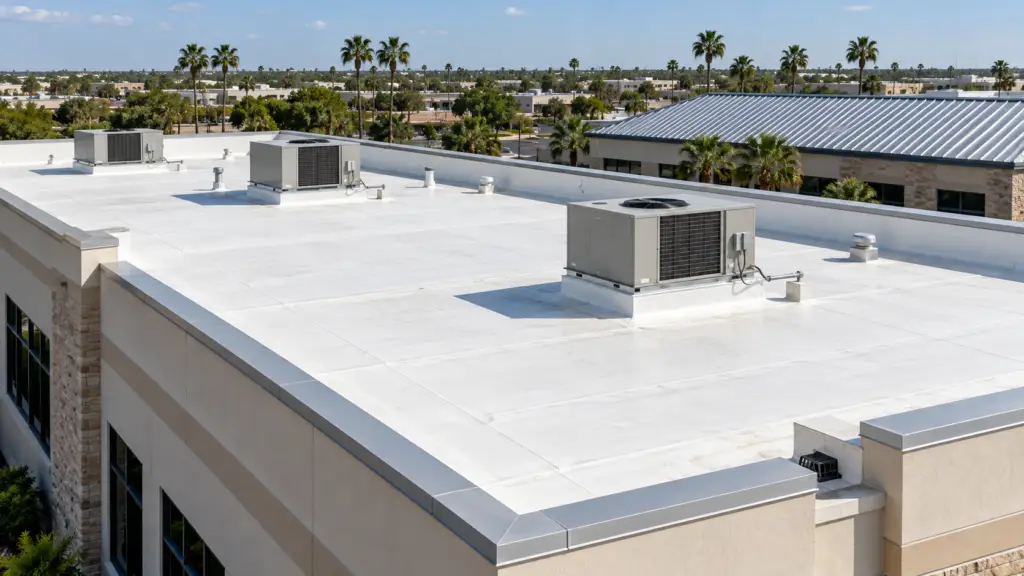
For commercial TPO roofing, ask for the membrane specification, insulation and cover-board details, attachment method, drainage plan, and flashing details. A familiar material name alone does not tell you how the completed roof was designed or installed.
For commercial metal roofing, identify the actual system before applying a lifespan estimate. Standing seam, exposed-fastener panels, coatings, sealants, and accessories are not interchangeable.
A Metal Construction Association study projected more than 60 years for a particular low-slope, unpainted 55% aluminum-zinc alloy-coated steel standing-seam system installed using best practices. That finding is useful, but it is not a blanket promise for every metal roof. The study also emphasized inspections and attention to components that can corrode or need maintenance. Read the MCA study summary.
A roof warranty is not an expiration date
Do not treat a warranty term as a prediction of when the roof will fail. Before choosing a proposal, ask for the actual warranty document and a plain-language explanation of what it covers, what it excludes, who responds to a problem, and what maintenance or reporting duties remain with the owner.
Keep the workmanship warranty separate from any manufacturer coverage in your comparison. A longer term on the front of a proposal is not enough information to decide which roof is the better investment.
Repair, restore, recover, or replace?
Roof age should trigger planning, not an automatic sales decision. Ask the contractor to explain which of these paths fits the documented condition:
- Repair: Address a defined problem when the surrounding assembly remains serviceable. Ask what caused the problem and how the repair addresses that cause.
- Restore with a coating: Consider this only after checking whether the existing roof and proposed coating system are compatible and suitable.
- Recover: Evaluate whether a new assembly can be installed over eligible existing materials. This requires a project-specific review of condition, moisture, structure, and applicable requirements.
- Replace: Compare replacement when inspection identifies extensive deterioration, significant moisture problems, or recurring failures that targeted work will not reasonably resolve.
GAF’s restoration guidance calls for replacing wet membrane and insulation and testing coating adhesion. A coating proposal should therefore include preparation and necessary repairs—not simply a price to cover the roof. See GAF’s asphaltic roof coating guidance and its roof recover overview.
Explore our commercial repair, roof coating, and replacement options before choosing a direction.
Give maintenance a place in the operating budget
Johns Manville recommends checking key commercial roof areas at least twice a year. For an RGV building, arrange professional follow-up after significant storms or when a new leak appears, and follow the roof manufacturer’s maintenance requirements.
- Keep drainage paths, drains, and scuppers clear.
- Document seams, flashings, penetrations, and roof-edge conditions.
- Record rooftop service visits and any new equipment or penetrations.
- Keep dated photographs, repair records, warranty documents, and inspection reports together.
- Assign someone to follow through on recommended repairs.
Use qualified personnel for roof access and inspections. Source: Johns Manville’s commercial roof maintenance guidance. Our commercial roof maintenance page explains the next step locally.
What to ask at your next roof inspection
Request answers you can use to make a business decision:
- What roof system and layers do we have?
- Which problems need immediate attention, and which can be monitored?
- Is there evidence of moisture beneath the surface, and is further testing needed?
- What supports the repair, restoration, or replacement recommendation?
- What should we budget now, and what should we plan for later?
Compare the scope behind each estimate. Include the effect on tenants, stock, equipment, access, and business hours. A low repair price is only helpful if it addresses the problem; a replacement proposal should explain why the existing roof cannot reasonably be kept in service.
Frequently asked questions
Does a 20-year-old commercial roof automatically need replacement?
No. Its condition, system type, repair history, and the findings of an inspection matter more than age alone. Ask for evidence before committing to a full replacement.
Can a roof coating add another 20 years?
Do not assume a fixed extension. Suitability, preparation, system specifications, and ongoing maintenance matter. Ask what the proposed system is designed to do and review its actual warranty terms.
Is a leaking commercial roof always at the end of its life?
No. A leak may come from a localized detail. It still needs prompt evaluation so you can understand the source and whether the wider assembly is affected.
How can I find out how much life my roof has left?
Start with a documented inspection and the roof’s records. A remaining-life estimate should explain its assumptions and any further investigation needed, rather than promise an exact failure date.
Plan your next step with Marva Roofing
Marva Roofing is a family-owned, veteran-owned roofing company serving commercial property owners across McAllen, Edinburg, Mission, Pharr, and the Rio Grande Valley. If you are deciding whether to repair, maintain, restore, or replace a roof, start with a clear picture of its condition.
Request a commercial roof inspection or call (956) 217-9989. For planning, review our commercial roofing cost guide.